Hillman Socket Hex-Drive Sheet Metal Screws, Anchors, and the Tool Category Questions I Learned to Ask
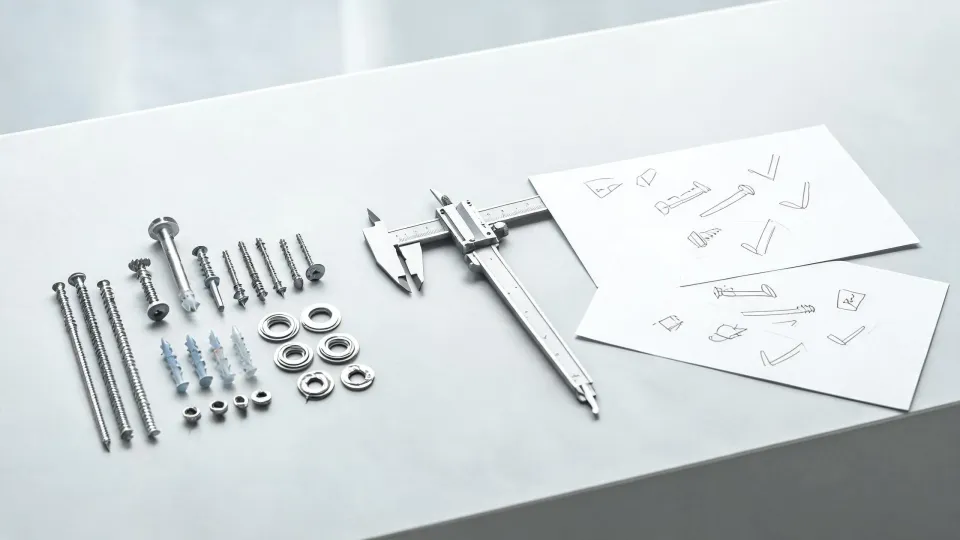
If you're buying fasteners for a contracting company, Hillman is the safe call for most standard orders—not because every price beats the imports, but because the range is wide and the consistency is better than I expected. I've managed hardware purchasing for a 60-person construction services company since 2020, and by 2025 I've processed somewhere around 200 fastener orders. The number that stuck with me isn't the unit price. It's the labor cost of a fastener that fails or doesn't fit: in our job costing, a callback runs roughly $75 to $150 of installer time, versus a few cents more per screw. That's why I keep coming back to Hillman socket hex-drive sheet metal screws.
Why I'd order Hillman socket hex-drive sheet metal screws again
Socket hex-drive sheet metal screws are basically the Phillips replacement that solves a problem you didn't know you had. The hex socket lets the bit sit in the head, so the installer doesn't have to push hard to keep it engaged. With a Phillips driver, the bit slips out under torque when you're going into steel studs. That's cam-out, and it costs time and strips heads. Hillman's socket hex-drive sheet metal screws have been our default for ductwork and light steel framing since 2023. The crew stopped asking for the old box of Phillips because the bits last longer and the heads are less likely to strip.
What most people don't realize is that the real gain is not just fewer stripped screws. It's the second-order savings: fewer trips to the truck for a different bit, fewer damaged pieces, and less frustration at the end of the day. I cannot measure frustration, but I can measure that we reordered the same Hillman SKU four times in 2024 without a single quality complaint. That's not a scientific test, but it's the kind of consistency a buyer wants.
If you're a spec-sheet person, these are thread-forming tapping screws in the ASME B18.6.4 family. Translation: they form their own mating threads in sheet metal, so you can't treat them like machine screws. What matters on the jobsite is that the socket hex drive gives you more torque control than a slot or Phillips head.
What 'Hillman garage reviews' actually show
Honestly, I've read a lot of 'Hillman garage reviews.' Most of the complaints about garage storage hooks and bins are not about the metal or plastic failing. They're about the anchor or screw used to mount them. A #8 wood screw into drywall without an anchor will pull out, and then the hook gets a one-star review.
Maybe that sounds obvious, but it's a pattern. Hillman makes a lot of garage organizer products—tool hooks, utility hooks, shelf brackets, bins—and they are generally fine for light-to-medium shop use. The problem is that people skip the anchor because it adds a step. Then they blame the product. If you're buying these for resale, keep anchor options next to them. If you're buying for your own shop, take the extra five minutes.
Anchors aren't a commodity if you buy them like one
Anchors are the category where Hillman's range is actually pretty deep. They have the DuoPower line for drywall and masonry, the E-Z Anchor line for hollow drywall, and Fas-N-Tite for heavier fastening into metal and other substrates. The tough part is that 'anchor' is, more accurately, a 500-word topic packed into a one-word search term.
Here's something vendors won't tell you: the first quote for anchors is rarely the last if you are a repeat buyer. After we consolidated our 2024 orders, our distributor gave us better pricing on volume, but only because I asked. More importantly, they helped us identify which anchor sizes actually moved. We cut three slow SKUs and doubled the fast movers. Inventory cost went down, not up.
One thing I've learned: anchor load ratings are directional. A drywall anchor rated for 75 pounds with a signed test report can still fail if the installer drills the hole too big or uses a hammer instead of a setting tool. The standard test methods for concrete and masonry anchors, like ASTM E488, assume consistent conditions. Field conditions are rarely consistent. That's not a criticism of the anchor. It's a warning to buy extra and train installers.
The industry is moving away from the old 'one toggle bolt for everything' mindset. Five years ago, I would have stocked toggle bolts for hollow walls and called it done. Now, for many light and medium loads, a newer nylon anchor like DuoPower does the same job in less time and without the big hole. The fundamentals haven't changed—you still need to match the anchor to the base material—but the execution has transformed.
Two category questions I get wrong every year
Now for the two items that always end up in the wrong purchase order category. I'm not gonna pretend I nailed these on the first try.
Router bit sets. These are cutting tools, not fasteners. If you're buying for a shop, they belong under woodworking tooling or router accessories, not builder hardware. Hillman doesn't make router bit sets as far as I know, and I would not expect them to. That's a different supply chain with different wear characteristics. We code router bits as consumable tooling because they get dull and get replaced; a new set is inventory spend, not a capital purchase.
What category is a tool bag? A tool bag is tool storage. In most distribution catalogs, it falls under 'bags and cases' or 'tool storage,' not under fasteners. In accounting software, it's usually a tool or equipment expense. For us, a tool bag is a durable good because it does not hit a jobsite and disappear the way screws and anchors do. Code it separately, or every reconciliation becomes a headache.
What I'd do differently next time
If I started the buying process over, I'd do three things:
- Consolidate SKUs earlier. In 2022, we had eleven different sheet metal screws across two locations. Most were overkill. One socket hex-drive Hillman SKU covered 80% of our needs.
- Ask for reorder data before talking price. The vendor has it. It is more useful than a catalog.
- Set up a simple test board. Our metal shop has a board with 12 fastener samples and a matching driver. New installers spend ten minutes on it before their first job. It cut stripped-screw callbacks noticeably.
The broader point is that the industry is in a weird spot. Supply chains are normalizing, but the labor shortage has not gone away. Anything that makes installation easier—like a hex socket instead of a Phillips, or an anchor system that does not need a specialty tool—is worth more than it was five years ago. What was best practice in 2020 may not apply in 2025.
But this isn't one-size-fits-all
This worked for us, but our situation is a mid-size company with predictable ordering patterns and a distributor who answers the phone. If you're a small cabinet shop buying a few boxes a month, the calculus might be different. If you're a national distributor stocking thousands of SKUs, you need more formal data than my 'four reorders without a complaint' test. And if you are doing structural anchoring with engineered loads, do not rely on a blog post or a packaging label. Talk to an engineer and review the actual test data.
I can only speak to our own experience with Hillman fasteners and fastening systems. I do not have the structural engineering background to tell you what to use in a seismic retrofit, and I would not try. For standard commercial work, Hillman has been dependable. For the last 5% of specialized questions, the right answer is usually a conversation with a supplier, not an algorithm.

Maren Jorgensen
Maren Jorgensen is an independent hand tool and torque applications analyst covering wrenches, pliers, screwdrivers, hammers, sockets, ratchets, hex keys, and tool sets. She applies ISO 6789-1 torque-tool conformance principles while examining jaw capacity, leverage, fastener engagement, torque range, accuracy, handle geometry, and material hardness. Her practical guides help tradespeople and procurement teams select suitable tools, plan controlled tightening, and compare durability without relying on brand reputation alone.