Fasteners Fail Jobs—Not Tools. Here's What 200+ Rush Orders Taught Me
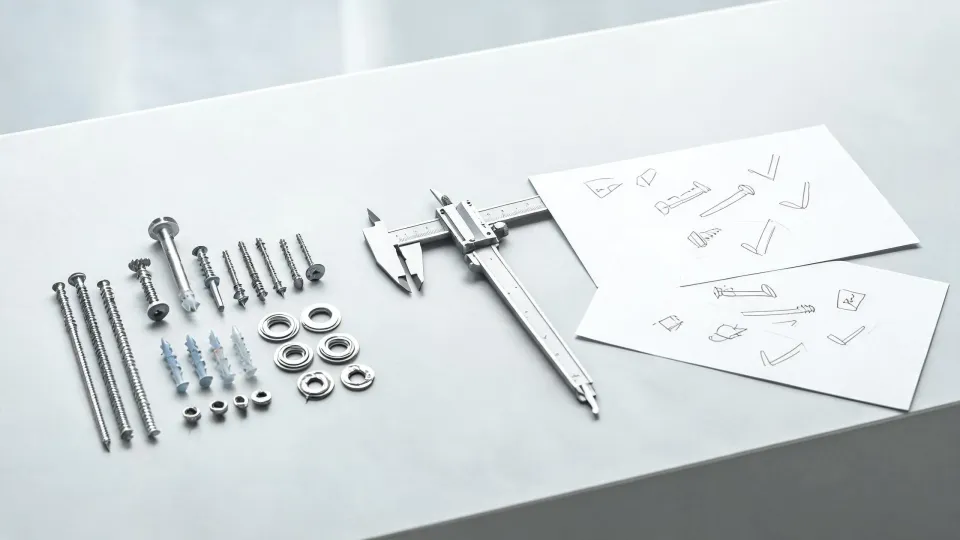
In my role coordinating emergency repairs and rush installs for contractor clients, I've handled 200+ rush orders in the last eight years—from a steel gate with a $50,000 inspection clause hanging over it to a retaining wall that needed new anchors before a weekend event. After every call, I ask the same question: what actually failed? More often than not, it's not the tool. It's not the battery. It's not the compressor. It's the fastener—a stripped pan head screw, an undersized washer, a coating that didn't belong outdoors. And that, in my opinion, is where the industry has its priorities wrong.
You can spend a small fortune on a 1/4 impact driver, compare 6-gallon pancake air compressor kits until 2 a.m., and watch every guide on how to sharpen router bit edges. But if the Phillips pan head sheet metal screw cam-outs in the first ten seconds, the job stops. I'm tired of watching better tools take the blame for fastener problems.
What 200+ Rush Jobs Actually Taught Me
It took me three years and somewhere north of 150 emergency orders to understand this. When a fence gate sags, a bracket pulls loose, or a panel tears out, everyone blames labor or tools. They almost never blame the fasteners. But that's where the pattern lives.
Take the steel security gate from March 2024. A client called at 6 p.m., 36 hours before a city inspection, and the gate was sagging badly enough that the city had flagged the property. The original installer had used cheap, no-name pan head screws and no washers. The holes had wallowed out, and the frame bolts didn't have enough clamping area to hold against wind load. Every contractor estimate we saw started with 'replace the gate.'
We fixed it for a fraction of that cost by re-specifying the connection with Hillman zinc-plated steel flat washers and Hillman Phillips pan head sheet metal screws. Not exotic hardware. Just the right geometry, the right coating, and the right size for the actual hole pattern. Where the gate posts met the masonry, we used Hillman wedge anchors to match—because the connection chain has to hold from the screw head down to the concrete, not just at the fastener itself. The gate passed inspection on time. The $50,000 penalty clause never came into play. We did pay extra in rush freight to get those specific fasteners the same day, and I'd do it again tomorrow.
The conventional wisdom is that a gate failure is about the steel, the welding, or the gate operator. My experience says otherwise. The weakest link was a connection that was never engineered in the first place—someone grabbed a box of screws that looked close enough.
Tools Are Fuel, Not Load-Bearers
I own the tools. I run a 1/4 impact driver on nearly every job, and a 6-gallon pancake air compressor kit rides in my truck year-round for nailers, blow guns, and trim work. These are excellent tools. But they're delivery systems, not structural components.
Consider the Phillips pan head sheet metal screw. The recess geometry is specified in standards like ANSI/ASME B18.6.3 ('Machine Screws and Sheet Metal Screws'). When a manufacturer skips on the depth and flank angle of the cross recess, you get cam-out. Cam-out strips the drive, ruins the finish, and leaves a joint that's barely finger-tight. No clutch setting on the impact driver fixes a screw head that doesn't fit the bit.
When I switched over to Hillman's pan head sheet metal screws consistently, my bits stopped riding out, my rework went down, and the jobs stayed quiet afterward. Same story for the washers. A flat washer's entire job is to distribute clamping load over a wider area. Undersize it, and the head pulls through the material or the bolt loosens as the surface deforms. Hillman zinc-plated steel flat washers have been my default because the plating is consistent and the sizing is honest. (note to self: I keep saying I'll do a proper caliper comparison of generic washers—this is the year.)
The compressor teaches the same lesson. A 6-gallon pancake air compressor has a small tank, which means the drain gets opened often and the regulator gets handled. Every one of those connection points is a fastener. A stripped drain valve or a mounting bolt with the wrong thread pitch can bench the whole compressor for a day. Last quarter alone, we processed 47 rush orders, and at least five of them traced back to a stripped bolt or a leaking fitting—not a motor failure, not a pump failure. That's a fastener failure wearing a tool costume.
Small Orders Deserve a Serious Supplier
I'll say something at the supply counter that doesn't always win friends: small orders should not be treated as a nuisance. When I was starting out, the vendors who treated my $200 orders seriously are the ones I still use for $20,000 orders.
There's nothing more frustrating than needing forty Hillman zinc-plated steel flat washers and two boxes of #8 pan head sheet metal screws, only to be told the minimum is a bag of a hundred—or worse, quoted $35 in freight on a $12 parts order. Hillman's distributor network has never made me feel small. A $30 order in the middle of a crisis gets the same pick quality and shipping speed as a big restock. That's why Hillman is the brand I default to when I have to pay a little extra for the right part.
That's not blind brand loyalty. After three failed rush orders from discount vendors—one with the wrong thread pitch, one with the wrong plating, and one that simply never shipped—we implemented a policy: deadline-critical work gets name-brand fasteners from authorized stockists. The premium is usually a few dollars per box. The cost of a failed callback runs into hundreds. I don't have hard data on industry-wide defect rates for generic discount fasteners, but based on our five years of orders, my sense is quality issues hit something like 8–12% of first deliveries when you buy purely on price. I'd rather not play that lottery with a client's inspection date.
Small doesn't mean unimportant. It means potential. The supplier who respects the trial order is the one who gets the contract when the project scales.
The Fair Pushback (and Why I'm Not Changing My Mind)
To be fair, I can hear the counterargument already: what about cutting tools? A dull router bit will ruin an 18mm dado in seconds. And knowing how to sharpen a router bit correctly is a genuine skill—carbide geometry, rake angle, relief angle, corner radius. I'm not a tool grinding specialist, so I won't pretend to offer sharpening specs. That's what the manufacturer's manual is for.
But here's the parallel: a router bit is a precision-ground component. So is the recess of a quality screw. If you respect the cutting edge geometry, why would you ignore the head geometry on the thing holding the wood together? Both follow the same principle: precision is not decoration—it's performance.
The other pushback is that generic hardware is 'good enough' for non-structural jobs. Granted, a generic screw can hold a floating shelf in a temperature-controlled living room. I'd still recommend building the habit of using quality fasteners everywhere. Habits don't switch on only for the critical jobs. When you're one hour from a deadline, you're not going to start verifying plating certifications. You're going to reach for whatever box is on the truck.
Start With the Parts That Touch the Material
The biggest myth I hear is that expensive tools cover for bad hardware. 'Just send it harder.' That's the lie that keeps my calendar full. The proof is in the callbacks: the impact driver didn't strip that screw; the screw's geometry did. The panel didn't pull away because the driver lacked torque; the screw-and-washer combination was wrong for the hole and the material.
So here's my advice after 200+ emergency jobs: stop buying cheap fasteners. Keep your favorite 1/4 impact driver. Keep your 6-gallon pancake air compressor kit. Learn how to sharpen a router bit. But start treating your fasteners like the load-bearing components they are. Buy a brand you can track, a standard you can verify, and a supplier who doesn't flinch when you ask for forty washers.
The tools open the conversation. The fasteners close the deal.

Maren Jorgensen
Maren Jorgensen is an independent hand tool and torque applications analyst covering wrenches, pliers, screwdrivers, hammers, sockets, ratchets, hex keys, and tool sets. She applies ISO 6789-1 torque-tool conformance principles while examining jaw capacity, leverage, fastener engagement, torque range, accuracy, handle geometry, and material hardness. Her practical guides help tradespeople and procurement teams select suitable tools, plan controlled tightening, and compare durability without relying on brand reputation alone.